Example
Website and customer experience
An outdated website becomes a clearer customer path—and, where it pays, a connection into ordering, reservations, or CRM.
Related: Business Systems Modernization, AI & Business Opportunity Assessment
Carlton Brooke
Carlton Brooke helps organizations use AI and better business systems to improve how they work.
We work directly with owners and senior decision-makers to identify opportunities, design practical solutions, and help implement them.
We don't start with AI. We start with your business.

How we engage
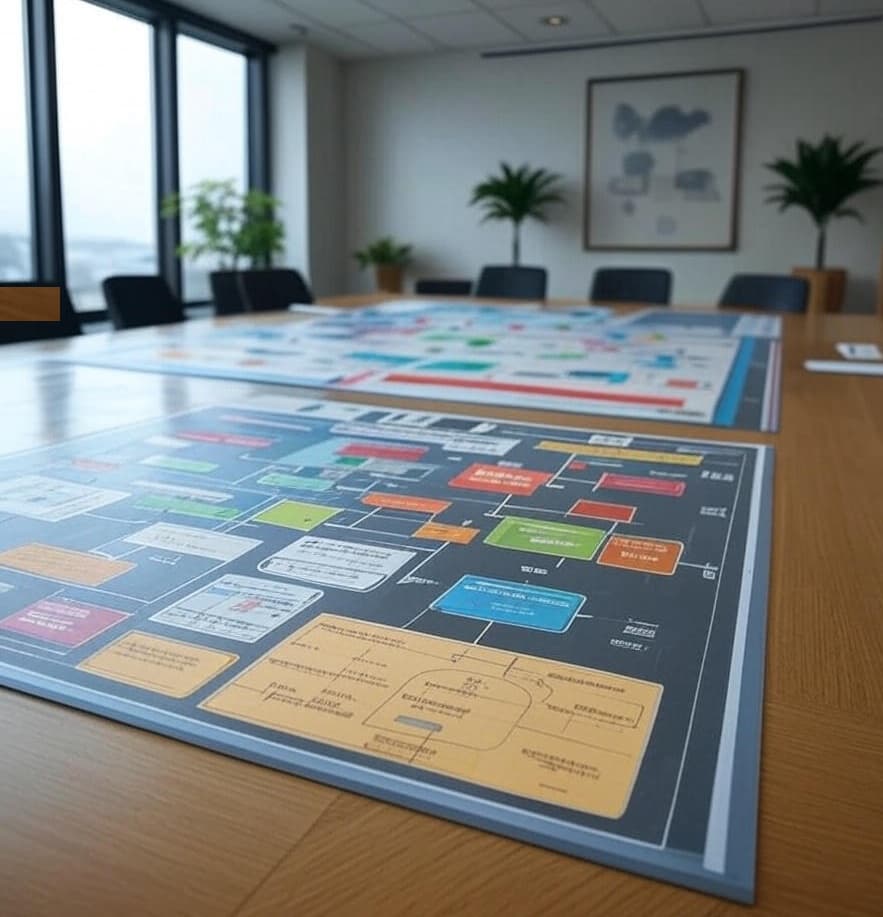
The work starts with how operations actually run: workflows, systems, information, and the decisions that move the organization. We look for changes that create measurable business value—and we recommend not doing the work when the economics do not hold.
We look for work that can increase revenue, reduce cost, recover capacity, improve cash flow, support better decisions, or reduce meaningful risk. If the economics do not hold, we recommend not doing it.
Find where customer experience, follow-up, or capacity is leaving money on the table.
See which manual processes, tools, and rework are consuming operating expense.
Free people from repetitive searching, entering, reconciling, and chasing.
Shorten delays in billing, collections, ordering, and operational handoffs.
Give owners useful information about customers, margins, labor, and cash.
Lower dependence on fragile spreadsheets, tribal knowledge, and error-prone work.
Flagship engagement
“I know AI is changing business, but what could it actually do for my business?”
An engagement that starts with your business—not with a list of AI tools—and produces a prioritized opportunity roadmap grounded in measurable value.
Typically 1–2 weeks.
Clear value, practical effort, acceptable risk. Worth starting.
Worthwhile after a dependency is cleared or a baseline is improved.
Promising, but value, data, or feasibility still needs proof.
The economics do not hold. We will say so. Not every AI idea should be built.
Most relationships begin with the assessment. Implementation and ongoing advisory follow when the business case is clear.
Make the systems that run the business work together—website, accounting, CRM, POS, scheduling, documents, and the spreadsheets in between.
Learn more →Understand the current workflow, estimate what it costs in time and money, redesign it, and automate only where it earns its keep.
Learn more →Data and financial intelligence is achieved through intelligent information design—not simply by connecting systems or building dashboards. Carlton Brooke's Agile Information-Modeling Methodology turns fragmented operational data into trusted business information for management, analytics, and AI.
Learn more →Bounded implementation of a worthwhile AI capability after the business case is clear—not an open-ended transformation program.
Learn more →An optional continuing relationship after assessments and projects: independent guidance on vendors, investments, and the next worthwhile opportunity.
Learn more →A simple consulting lifecycle. Prototype and build sit inside design and implementation when they reduce uncertainty. Ongoing advisory is optional.
1. Discover
We start with your business: how you make money, how work actually gets done, which systems you already use, and where time, cash, and attention are consumed.
2. Design
We design a practical approach: what to keep, improve, integrate, replace, or automate—and whether conventional process change or AI is the right tool.
3. Implement
We implement bounded improvements: a redesigned workflow, a clearer information picture, a modernized customer path, or a focused AI capability.
4. Advise
When it is useful, we stay involved as an ongoing AI and systems advisor: reviewing vendors, prioritizing investments, and spotting the next worthwhile opportunity.
Illustrative situations, not client case studies. They show the kind of problems we work on and the outcomes we aim for.
Example
An outdated website becomes a clearer customer path—and, where it pays, a connection into ordering, reservations, or CRM.
Related: Business Systems Modernization, AI & Business Opportunity Assessment
Example
Accounting and operational information are organized so owners can see what is happening—not only what already happened.
Related: Data & Financial Intelligence, AI & Business Opportunity Assessment
Example
Procedures, documents, and institutional knowledge become answers employees can trust—instead of another hunt through files and inboxes.
Related: AI Implementation, AI & Business Opportunity Assessment
Example
Email, spreadsheets, and repetitive entry are redesigned into a cleaner process, with automation or AI only where they earn their keep.
Related: Workflow Automation, AI & Business Opportunity Assessment
Carlton Brooke brings business understanding, financial and accounting expertise, systems experience, and practical AI implementation together in one place. The differentiator is not a tool. It is the willingness to evaluate a proposed initiative the way an owner would: does it increase revenue, reduce cost, recover capacity, improve cash flow, improve decisions, or reduce risk?
If it does not, we will recommend not doing it.
About Carlton Brooke →
Tell us how the work actually runs. We will help you see where technology is worth it—and where it is not.